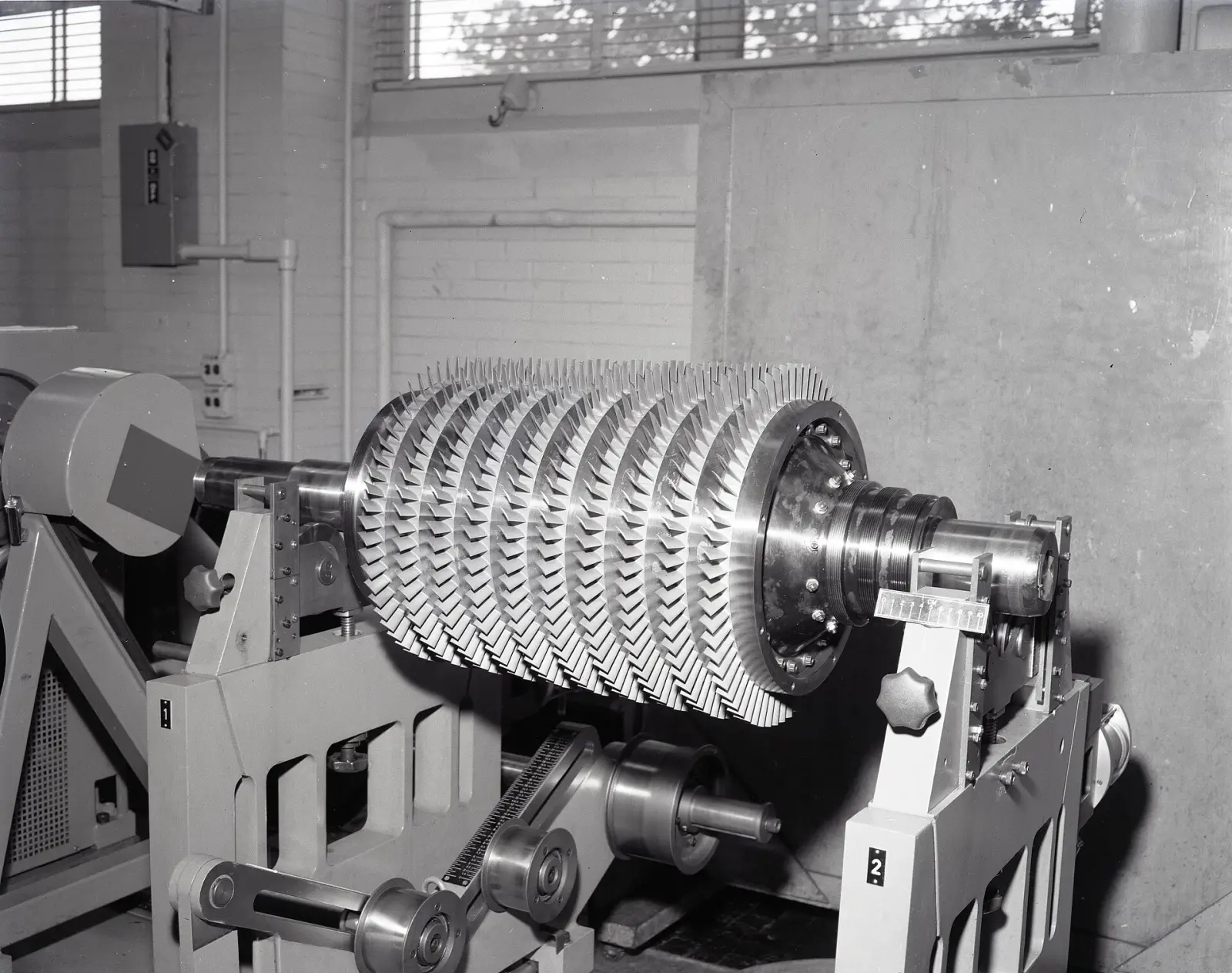
A rotor balanced on a workshop balancing machine can still vibrate on site because of assembly tolerances, couplings, pulleys and bearing conditions. Field balancing corrects the machine at real speed and as installed, which is often more accurate and much faster.
Using a portable multi-channel vibration analyser and a laser/optical phase reference, we measure the amplitude and phase of the 1X vibration. A trial weight determines the influence coefficient, the required correction mass and angle are calculated, and the weight is attached by welding, bolting or clips. The result is verified against the target ISO 21940-11 grade.
Benefits
No removal or shipping
The rotor stays in place — no cranes, transport or workshop waiting time.
Short downtime
Most single-plane jobs are completed within a few hours.
Longer bearing life
Unbalance force grows with the square of speed; reducing it directly lowers bearing, seal and housing loads.
Energy and noise
Energy lost to vibration and structure-borne noise drop; foundations and joints are protected.
Process
Safety & setup
LOTO, access, reflective tape and sensor mounting.
Baseline
Overall level, spectrum and 1X phase at all bearings; confirming the unbalance diagnosis.
Trial weight
A known mass at a known angle determines the influence coefficient.
Correction
Applying the calculated weight, with trim runs if needed.
Verification & report
Before/after comparison and ISO classification in the delivered report.
Deliverables
- Before/after amplitude and phase table
- FFT spectrum plots
- Weights applied and their angular positions
- ISO 21940-11 balance grade assessment
- ISO 20816 / 10816 zone classification
- Findings and recommendations
Applications
- Fans and blowers
- Pumps
- Electric motors
- Crushers and mills
- Separators and decanters
- Compressors
- Cooling tower fans
- Pulleys and spindles
- Generator and turbine rotors
Frequently asked questions
Single-plane or two-plane balancing?
Narrow (disc-type) rotors, such as fans whose length is small compared with their diameter, usually need only single-plane balancing. Long rotors or fans between bearings combine static and couple unbalance and require two-plane balancing. We decide from the phase relationships in the baseline measurement.
Why can vibration remain high after balancing?
If the source is not only unbalance — misalignment, looseness, resonance, a bent shaft or a bearing defect — balancing alone will not solve it. That is why we diagnose before balancing and list any additional corrections in the report.
How is the weight attached?
Depending on the equipment and safety requirements we use welding, bolted weights, balancing clips or material removal (grinding/drilling). On high-speed machines it is critical that the weight is secured against centrifugal force.