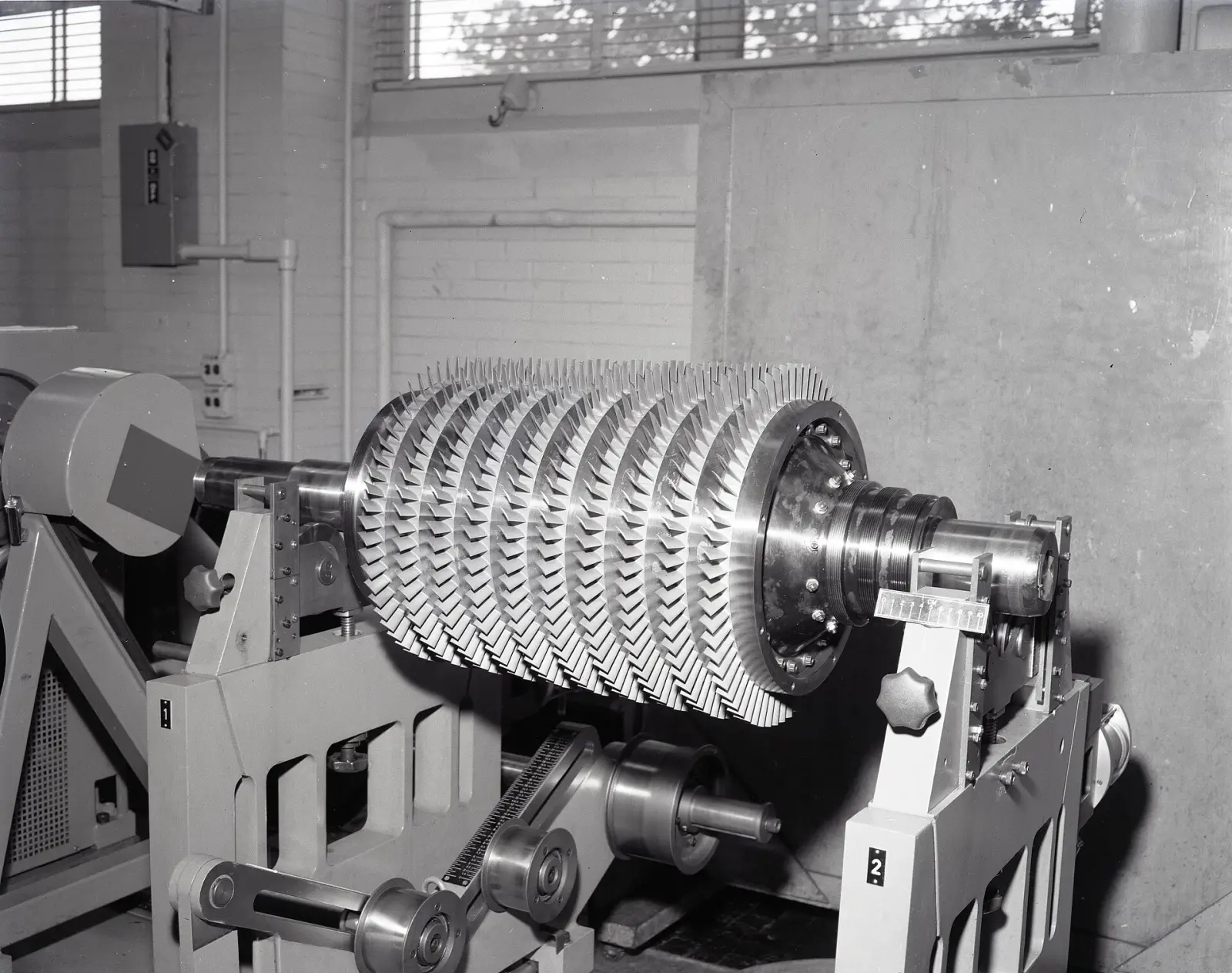
We have balanced a rotor — but how balanced is balanced enough? The internationally recognised answer is ISO 21940-11. It replaced the former ISO 1940-1 and defines the permissible residual unbalance for rigid rotors.
What does the grade (G) mean?
The balance quality grade G is expressed in mm/s and is the product of specific unbalance and angular velocity:
G = e_per · ω
Here e_per is the permissible offset of the centre of mass from the axis of rotation (µm, or g·mm/kg) and ω is the angular velocity (rad/s). The logic: the same offset produces a much larger force at higher speed, so high-speed rotors are allowed a smaller offset.
Grades step by a factor of 2.5: G0.4, G1, G2.5, G6.3, G16, G40, G100 and above.
Which grade for which equipment?
| Grade | Typical applications |
|---|---|
| G16 | Drive shafts with special requirements, crusher parts, agricultural machinery |
| G6.3 | Fans, pumps, flywheels, centrifuge drums, paper machine rolls, medium and large motor rotors |
| G2.5 | Gas and steam turbines, turbo-compressors, machine tool drives, small motor rotors |
| G1 | Grinding machine drives |
| G0.4 | Precision grinder spindles, gyroscopes |
For most industrial fans and pumps, G6.3 is the right target. G2.5 is preferred for precision, high-speed or vibration-sensitive equipment. For fans, ISO 14694 additionally defines application-specific categories.
How is permissible residual unbalance calculated?
U_per = 1000 · G · m / ω [g·mm]
Practical form: U_per ≈ 9549 · G · m / n
G: balance grade (mm/s)m: rotor mass (kg)n: maximum service speed (rpm)
Worked example
A 250 kg fan impeller running at 1480 rpm with a G6.3 target:
U_per ≈ 9549 × 6.3 × 250 / 1480 ≈ 10,162 g·mme_per ≈ 40.6 µm- With a 400 mm correction radius, the permissible residual mass is
10,162 / 400 ≈ 25.4 g
So a residual unbalance below 25 grams at a 400 mm radius meets G6.3 for this fan. Try other values with our ISO 21940-11 Balance Tolerance Calculator.
How is the tolerance split between two planes?
For a symmetric rotor (centre of mass midway between bearings), Uper is split equally between the two planes. If the centre of mass is closer to one bearing, the plane on that side gets a larger share. ISO 21940-11 describes in detail how to allocate it based on bearing distances.
Is balance grade the same as vibration?
No. The grade describes how well balanced the rotor itself is. Vibration measured on site is the sum of many factors besides rotor balance: bearing condition, foundation stiffness, alignment and resonance. After field balancing we therefore use two criteria together:
- The residual unbalance after correction is below Uper,
- Machine vibration falls in zone A or B of the ISO 10816-3 evaluation zones.
Conclusion
ISO 21940-11 makes "good balance" measurable. Choosing the right target grade for the equipment type and operating conditions protects you both from the cost of unnecessary precision and from failures caused by insufficient balance. Contact us if you want help setting the right target for your equipment.