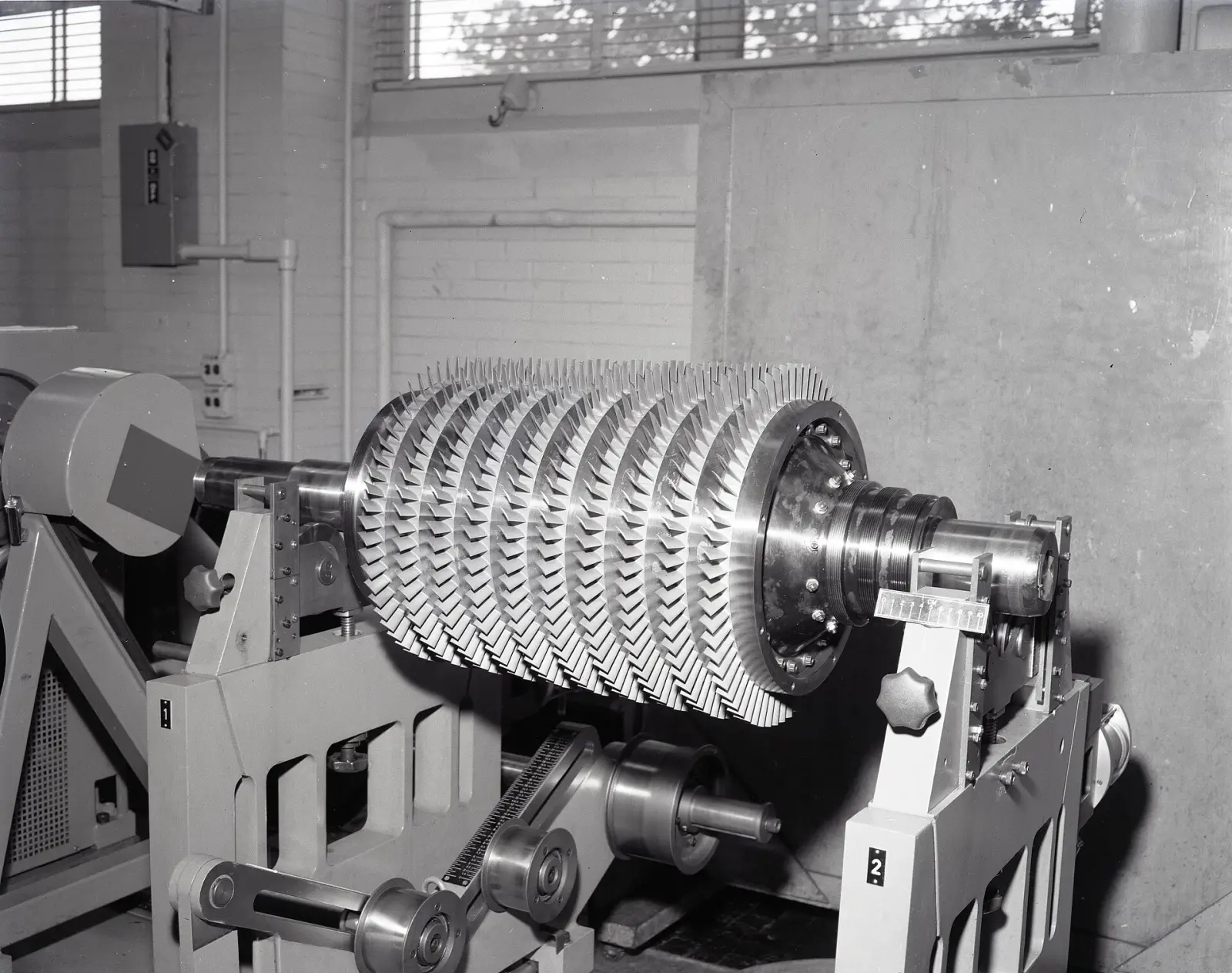
In rotating equipment, unbalance means the centre of mass does not coincide with the axis of rotation. Each revolution, the rotor applies a centrifugal force to its bearings that grows with the square of speed. The results are vibration, noise, bearing and seal damage, loosened bolts and, eventually, unplanned downtime.
Field balancing (on-site balancing) corrects that unbalance without removing the rotor — in its own bearings and at real operating speed.
Shop balancing vs. field balancing
A balancing machine in a workshop can balance a rotor very precisely under controlled conditions. But once the rotor is back on site, couplings, pulleys, shaft-hub clearances, assembly tolerances and bearing conditions can introduce new unbalance.
| Criterion | Shop balancing | Field balancing |
|---|---|---|
| Removal and transport | Required | Not required |
| Conditions | Machine's bearings, low speed | Real assembly, operating speed |
| Downtime | Days | Often hours |
| Assembly effects | Not captured | Corrected |
That is why, for fans, pumps, motors and separators, field balancing is often both faster and more effective at reducing the vibration that actually occurs on site.
Is the vibration really caused by unbalance?
This is the first question to ask. Unbalance typically shows this signature in the spectrum:
- A dominant peak at running speed (1X),
- High vibration in the radial directions (horizontal and vertical), relatively low axially,
- A stable, repeatable phase reading.
Misalignment, mechanical looseness, resonance, a bent shaft or bearing defects produce different signatures. Balancing in their presence may bring temporary relief but will not solve the problem. That is why every balancing job of ours starts with vibration analysis.
Single plane or two planes?
- Single-plane (static) balancing suits disc-type rotors whose length is small compared with their diameter, such as single-wheel blowers and narrow fan impellers.
- Two-plane (dynamic) balancing is needed for long rotors, which combine static unbalance with couple unbalance. Fans between bearings, rolls and long motor rotors usually need two planes.
The decision comes from the phase relationship at the two bearings: similar phases indicate static unbalance; roughly 180° apart indicates dominant couple unbalance.
Field balancing step by step
1. Safety and setup
Lockout-tagout (LOTO) is applied and access to the rotor is arranged. Reflective tape is attached to the shaft or hub for the phase reference and accelerometers are mounted on the bearings.
2. Initial run (O)
The machine runs at operating speed and the amplitude and phase of the 1X vibration are measured. This is the starting vector for the correction.
3. Trial weight (T)
The machine is stopped and a trial weight of known mass is attached at a known angle from the reference mark. It must be large enough to clearly change amplitude or phase, but small enough not to stress the machine.
4. Trial run (O+T)
The machine runs again at the same speed and the new amplitude/phase is read. The difference between the two vectors is the effect of the trial weight, from which the influence coefficient is calculated.
5. Correction and verification
Using the influence coefficient, the correction weight and angle that cancel the initial vibration are calculated, and the weight is secured by welding, bolting or clips. If the verification reading is not good enough, a small trim correction follows.
You can run the full calculation in your browser with our Single-Plane Balancing Calculator.
When is it balanced "well enough"?
The acceptance criterion is defined in two ways:
- Residual unbalance: the permissible residual unbalance for the ISO 21940-11 balance grade (usually G6.3 for fans). Use our ISO 21940-11 balance tolerance tool to calculate it.
- Vibration severity: the ISO 10816-3 / ISO 20816-3 evaluation zones. Depending on machine group and foundation, the result should fall in zone A or B.
Conclusion
When correct diagnosis, correct measurement and correct calculation come together, field balancing is one of the fastest and most effective ways to extend the life of rotating equipment. If you notice rising vibration on your machines, get in touch and we will plan the measurement together.